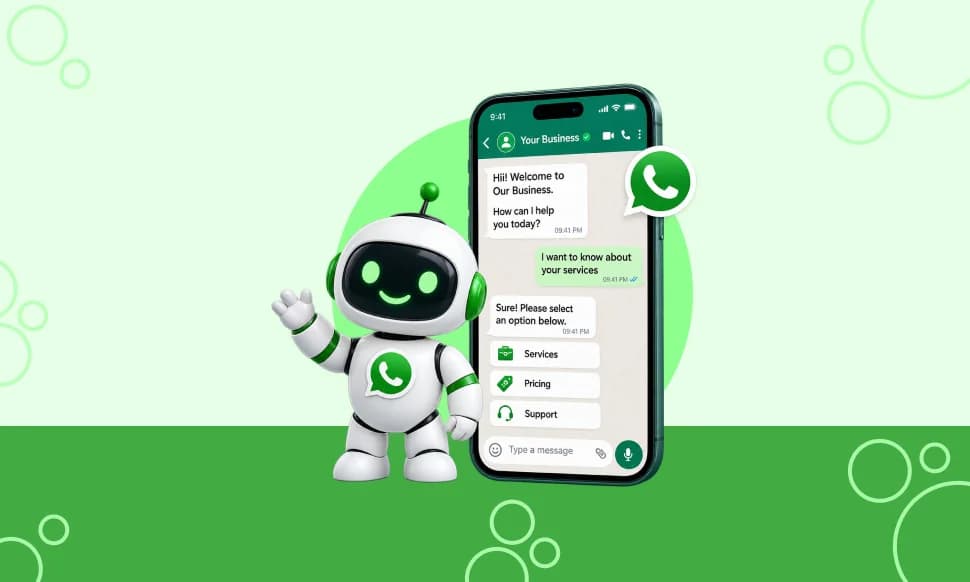
Most Indian businesses are running chatbots that frustrate customers rather than serve them. This complete buying guide covers what to build, where to deploy it, and what it actually costs.
Why Your Current Chatbot Is Probably Hurting You
There are two kinds of chatbots in the Indian market right now. The first kind is a flow-based chatbot — it presents you with buttons, takes you through a scripted decision tree, and collapses the moment you ask anything outside its pre-programmed menu. You've interacted with hundreds of these. You've been frustrated by all of them.
The second kind is an LLM-powered conversational AI — it understands natural language, answers questions from your actual product knowledge, handles context across a conversation, and escalates to humans intelligently when it genuinely can't help.
Most Indian businesses either have no chatbot, or have the first kind. The gap between the two experiences is enormous — and it's becoming a competitive differentiator.
A flow-based chatbot that can't understand 'I want to know about your pricing for a small team' is not a customer service tool. It's a friction generator. The bar is higher now. Your customers use ChatGPT daily. They know what a good AI conversation feels like.
Flow-Based vs. LLM-Powered: The Real Comparison
What AI Chatbots Are Actually Good At (In 2026)
- Answering product and service questions from your documentation — 'What's included in your monthly retainer?' 'Does your web development include SEO?' 'What tech stack do you use for mobile apps?'
- Lead qualification — gathering company size, use case, timeline, and budget in a conversational way that feels natural rather than interrogative
- Appointment and demo scheduling — integrated with your calendar, handling time zone questions, sending confirmations
- Order status and support queries — connected to your CRM or order management system, providing real-time updates without human involvement
- FAQ deflection — handling the 30-40 questions your support team answers daily, freeing them for complex issues
- Multilingual conversations — handling Hindi and regional language queries, critical for Indian businesses serving diverse markets
What AI chatbots are not yet consistently good at: nuanced negotiation, complex emotional support scenarios, decisions requiring genuine ethical judgment, and anything requiring real-time data access that you haven't provided explicitly.
WhatsApp vs Website Chatbot: Where to Start
WhatsApp AI Chatbot
For Indian B2B businesses: WhatsApp is where your buyers are. An AI chatbot on WhatsApp — accessed via a Click-to-WhatsApp button on your website or ads — reaches buyers on their preferred channel and achieves open rates of 85-90%.
WhatsApp AI chatbots work exceptionally well for: lead generation (initial qualification before human handoff), order management (status updates, returns, complaints), customer support (FAQ, account queries), and re-engagement campaigns.
Requirement: WhatsApp Business API access (WABA) via an approved BSP. See our WhatsApp lead generation article for the full setup guide.
Website AI Chatbot
Sits directly on your website, engages visitors at key moments, and converts more of your existing traffic without additional ad spend. Best positioned on: high-intent pages (pricing, services, contact), knowledge base pages, and post-content pages where visitors have read something and have follow-up questions.
Website chatbots are particularly effective as AEO/content supplement — they answer the questions your articles raised but didn't fully answer, keeping visitors on your site longer and moving them toward conversion.
Our Recommendation
For most Indian B2B businesses: start with a website chatbot to handle inbound enquiries, then layer in WhatsApp for outbound lead nurturing and customer support. They serve different moments in the buyer journey and work best together.
Already thinking about how to turn WhatsApp into a lead generation channel?
Most Indian B2B teams look at this next →
WhatsApp Business & CRM: The Lead Generation Stack That's Actually Working for Indian B2B Companies
How to Build a Good AI Chatbot: The Knowledge Architecture
The quality of an LLM chatbot is directly proportional to the quality of its knowledge base. An AI that has been given your website content, your FAQ document, your pricing PDF, your service descriptions, and examples of common customer conversations will perform dramatically better than one trained only on your homepage.
The knowledge architecture process:
- Audit every piece of content that answers customer questions — service pages, blog articles, past email templates, support ticket resolutions, sales call recordings
- Organise by query type: product questions, pricing questions, process questions, comparison questions, objection handling
- Identify the 20-30 questions your team answers most often — these become the chatbot's core competency
- Write explicit answers for edge cases and sensitive topics — pricing disputes, complaint escalation, competitor comparisons
- Define escalation triggers — when the bot should stop and transfer to a human, with what context
This knowledge architecture work is what separates a chatbot that helps from one that frustrates. Most agencies skip it and just feed the bot your website URL. The result is a bot that knows your service names but can't answer a specific pricing question.
This level of integration is closer to a web application than a widget.
Here is how 12Grids approaches builds like this →
Web App Development Services by 12Grids
The Build: What 12Grids Delivers
We build AI chatbots using LLM APIs (primarily Claude and GPT-4) combined with a RAG (Retrieval Augmented Generation) architecture that lets the bot retrieve specific, current information from your knowledge base rather than hallucinating answers from training data.
Our chatbot deployments include: website widget, WhatsApp Business API integration, CRM integration (lead records created automatically with conversation summary), human handoff with full conversation context, and an analytics dashboard showing top questions, resolution rates, and escalation patterns.
For God of Sports, our chatbot handles product queries, order status checks via WhatsApp, and cart recovery messages — significantly reducing the support load on their small team while improving response time from hours to seconds.
How Much Does an AI Chatbot Cost in India?
- Rule-based flow chatbot (website only): ₹30,000 – ₹1.5L one-time + ₹5,000-15,000/month maintenance
- LLM-powered website chatbot (basic): ₹1.5L – ₹4L build + ₹10,000-40,000/month running costs (API + hosting)
- LLM-powered WhatsApp chatbot: ₹2L – ₹6L build + ₹15,000-60,000/month (API + WABA costs)
- Full AI customer service suite (website + WhatsApp + CRM integration): ₹5L – ₹15L build + ₹25,000-1,00,000/month running
Running costs scale with usage volume. A chatbot handling 500 conversations/month costs materially less than one handling 50,000/month.
Wondering if your website is ready to support an AI chatbot?
Most clients check this before they build →
Website Development Services by 12Grids
Frequently Asked Quertions
Q: What is an AI chatbot for a website and how is it different from a regular chatbot?
A regular chatbot follows a fixed script — it gives you buttons, takes you through a decision tree, and fails the moment you ask something outside its menu. An AI chatbot powered by an LLM (large language model) understands natural language, answers questions from your actual product knowledge, and remembers context across the conversation. For Indian businesses, the difference is significant — your customers use ChatGPT daily and know what a good AI conversation feels like. A flow-based bot is a friction generator. An LLM-powered chatbot is a genuine support and sales tool.
Q: Can I run an AI chatbot on WhatsApp instead of my website?
Yes — and for most Indian B2B businesses, WhatsApp is where your buyers already are. A WhatsApp AI chatbot works through the WhatsApp Business API (WABA) and can handle lead qualification, order updates, customer support, and re-engagement — all with open rates of 85–90%. You can connect it to your website using a Click-to-WhatsApp button, so visitors move from your site to WhatsApp seamlessly. The recommended approach is to run both: a website chatbot for inbound enquiries and a WhatsApp chatbot for outbound nurturing and support.
Q: What does a conversational AI chatbot development service actually include?
A good development service goes well beyond just plugging in an AI widget. It starts with a knowledge architecture process — auditing your service pages, FAQs, pricing documents, past support conversations, and sales call patterns to build a knowledge base the bot can actually use. From there, the build includes LLM API integration (such as Claude or GPT-4), a RAG setup so the bot retrieves accurate answers instead of guessing, CRM integration for automatic lead capture, human handoff with full conversation context, and an analytics dashboard. What separates a useful chatbot from a frustrating one is the quality of this knowledge work — most agencies skip it and just feed the bot a website URL.
Q: How do I create a WhatsApp bot for my business?
You need WhatsApp Business API (WABA) access, which is obtained through a Meta-approved Business Solution Provider (BSP). Once that is set up, the bot is built on top of it — with a defined conversation flow, a knowledge base of your product and support content, and integrations to your CRM or order system. A basic WhatsApp AI chatbot build typically costs ₹2L–₹6L with monthly running costs of ₹15,000–₹60,000 depending on usage volume and API costs. For most businesses, the right starting point is a simple qualification flow of 3–5 questions, launched quickly, then improved based on real conversations.
Ready to Build a Chatbot That Actually Works?
We'll assess your current support and lead qualification workflow, identify where an AI chatbot creates the most value, and build one trained properly on your specific business knowledge.
→ Email: sales@12grids.com | +91 91379 97497

Kailash Vele
I lead the technology vision and architecture across all our products and client solutions — ensuring that innovation, scalability, and reliability are at the heart of everything we build. From Laravel to AI-powered systems, I work closely with our teams to implement frameworks that are not just functional, but future-ready. At 12Grids, I’m focused on driving engineering excellence, building clean and modular systems, and aligning our tech stack with business goals. Whether it’s launching a SaaS product, streamlining development workflows, or introducing automation for faster delivery, I believe great tech is built when structure meets speed. My core mission: to turn ideas into robust digital ecosystems that deliver real, measurable value.
Connect on LinkedInPut AI to work in your content engine
We design AI-native marketing workflows that ship - not demos.


Get the good stuff, monthly.
One thoughtful email a month - new research, playbooks, and ideas. No noise.