



Marketing
WhatsApp Business & CRM: The Lead Generation StackThat's Actually Working for Indian B2B Companies
8 mins | 13 Mar 2026
The Channel That Indian B2B Has Been Ignoring
Here's a number that should change how you think about lead generation: India has over 500 million active WhatsApp users. Your B2B buyers are on WhatsApp. Their procurement managers are on WhatsApp. The person signing your purchase order has a WhatsApp Business chat open right now.
And yet most Indian B2B companies treat WhatsApp as a personal communication channel — inconsistently managed, not tracked, not integrated with their sales pipeline.
The gap between 'we have a WhatsApp number for sales' and 'we have a WhatsApp-native lead generation system' is where significant pipeline is being left on the table.
Email open rates in India sit around 20-25%. WhatsApp message open rates sit around 85-90%. Your prospects are reading your WhatsApp messages. They're often not reading your emails.
This guide is about building the right stack — the combination of WhatsApp Business API, CRM, and automation — that turns WhatsApp from a chat window into a measurable lead generation engine.
WhatsApp Business App vs. WhatsApp Business API: The Distinction That Matters
Most small businesses start with the WhatsApp Business App — the free version you download from the Play Store. It gives you a business profile, quick replies, and basic labels. It's managed from a single device by one person at a time.
The WhatsApp Business API (WABA) is a different product. It connects WhatsApp to your backend systems, allows multiple agents to manage conversations from a dashboard, enables automated message flows, and provides analytics. It's what powers the professional lead generation stacks we're describing.
The API is accessed through official Business Solution Providers (BSPs) approved by Meta — companies like Interakt, Wati, Aisensy, or built directly via Meta's Cloud API for developers.
The cost difference is real: the App is free. The API costs ₹2,000-15,000/month depending on the BSP and message volume. The question is whether the lead generation improvement justifies it — and for most B2B companies doing meaningful volume, it does, quickly.
The Complete B2B Lead Generation Stack
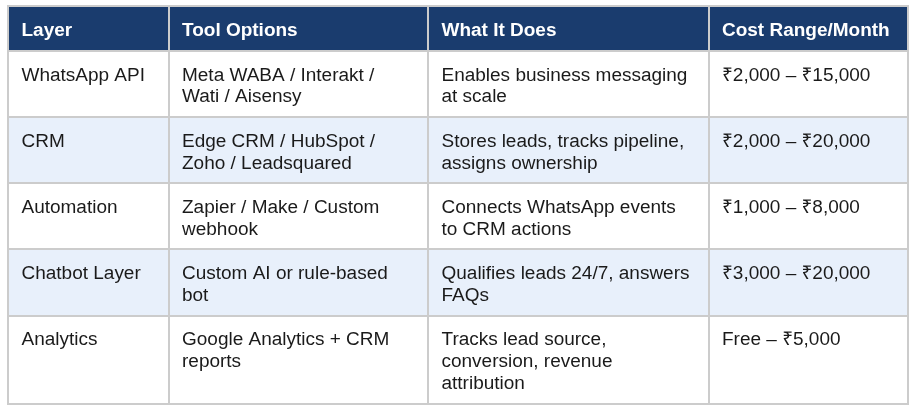
Total stack cost range: ₹8,000 – ₹68,000/month, depending on message volume, CRM choice, and automation complexity. Compare this to the cost of a single sales hire (₹25,000-80,000/month in salary alone, before overheads) — or a single lost deal that would have closed with better follow-up speed.
How the Stack Works Together — The Lead Flow
Here's a real lead flow we've built for B2B clients:
Stage 1: Capture
A prospect visits your website, clicks a 'Chat with us on WhatsApp' button (a Click-to-WhatsApp link or QR code). Alternatively, they respond to a WhatsApp-integrated Meta ad. Alternatively, they're reached via an outbound broadcast list from your existing database.
The moment they initiate contact, they appear in your WABA dashboard and simultaneously a new lead record is created in your CRM automatically via webhook integration.
Stage 2: Qualify
The chatbot layer activates immediately. It doesn't keep the prospect waiting. It asks qualifying questions — company size, use case, timeline — in a conversational way that feels natural on WhatsApp. Responses are captured and mapped to CRM fields automatically.
Leads above a qualification threshold (say: company size > 50 employees, timeline < 3 months) get routed directly to a sales rep with full context. Below threshold leads are added to a nurture sequence.
Stage 3: Nurture
WhatsApp nurture sequences are fundamentally different from email sequences. Messages are shorter. Frequency is lower (you'll get blocked if you message too often). But response rates are dramatically higher.
A B2B nurture sequence on WhatsApp might look like: Day 0 — relevant case study relevant to their industry. Day 3 — a question about their specific challenge. Day 7 — a product comparison or pricing guide. Day 14 — an invitation to a demo or a live Q&A session.
Each response triggers a CRM activity update. Engagement signals (opening messages, clicking links, responding) adjust the lead score automatically.
Stage 4: Convert
When a lead shows high intent signals (multiple message opens, response to nurture, visits to pricing page), the sales rep gets a CRM notification. They pick up the conversation with full context: what the lead asked initially, how they responded to nurture, which pages they visited on the website, their lead score.
No cold calls. No 'can you remind me what we spoke about.' Just an informed conversation that closes faster because both sides have context.
The WhatsApp Broadcast Strategy That Doesn't Get You Blocked
One of the most common WhatsApp marketing mistakes: broadcasting to everyone in your database with promotional content. Meta's algorithm detects high block rates and can restrict your WABA. This is how companies lose their business account.
The right broadcast approach:
- Only broadcast to opted-in contacts — people who've explicitly messaged you first or ticked a consent box
- Send content that creates value, not just promotion — industry updates, useful reports, relevant case studies
- Keep frequency below 2-4 messages/month unless the contact is actively engaged
- Personalise at segment level — at minimum, different messages for different industries or stages in your pipeline
- Track block rates — if they exceed 2%, pause and review your content before continuing
The companies getting the best results from WhatsApp broadcasts are sending content their audience would genuinely find useful — not just what the company wants to sell. This is the same principle that makes good email marketing work, applied to a higher-attention channel.
CRM Integration: Why Most WhatsApp Setups Fail
The most common WhatsApp B2B setup we see: one sales person managing a WhatsApp Business App, responding manually, with no record of conversations in any system. When they leave, all context leaves with them. When they're busy, leads wait — and in B2B, slow response is a competitive disadvantage.
A properly integrated CRM solves this:
- Every WhatsApp conversation is logged against the contact record automatically
- Lead ownership is clear — if a rep is on leave, another team member can pick up with full context
- Follow-up reminders are set automatically when a conversation goes cold
- Management has visibility into pipeline health without chasing individual reps
- Revenue can be attributed back to WhatsApp as a channel — so you can measure ROI
At 12Grids, we use and also build with Edge CRM — our own product, designed specifically for the Indian B2B context. It integrates natively with WhatsApp Business API, has a clean pipeline view, and is used by our own sales team. We know its capabilities because we depend on them ourselves.
Real Numbers: What This Stack Delivers
We'll share benchmarks from clients we've built this for (metrics are approximate to protect client confidentiality):
- Average WhatsApp message open rate: 82-91% (vs 22-28% for email)
- Lead qualification time: Reduced from average 48 hours (email back-and-forth) to under 2 hours (bot qualifies, rep follows up)
- Sales rep productivity: 40-60% more conversations managed per rep per day with the right dashboard setup
- Follow-up consistency: Near 100% (automated reminders) vs 55-70% without CRM integration
These aren't industry averages — they're what we see in practice with Indian B2B clients who implement this stack correctly. The improvement in follow-up consistency alone has measurable impact on pipeline conversion.
What to Set Up First — A 4-Week Implementation Plan
Week 1: Foundation
Apply for WhatsApp Business API access through a BSP. While that's processing (3-5 business days), audit your current lead management: where do leads come from, how are they tracked, where do they die in the pipeline?
Week 2: CRM Setup
Choose and configure your CRM. Map your sales stages. Set up lead scoring criteria. Import existing contacts with proper consent records. Connect WhatsApp API to CRM via webhook or native integration.
Week 3: Automation
Build your qualification chatbot flow (start simple: 3-5 questions max). Set up lead routing rules. Create automated follow-up sequences. Test the full flow from click-to-WhatsApp to CRM record creation.
Week 4: Launch and Calibrate
Run the system live with your sales team. Collect feedback on what the bot gets wrong, what questions prospects actually ask, what the lead scoring should be. Adjust. This system improves with usage.
The biggest mistake: waiting until everything is perfect before going live. Launch a simple version in week 4, learn, and iterate. Perfecting in theory while prospects wait is not a strategy.
How 12Grids Helps You Build This
We offer three ways to work together on WhatsApp-CRM lead generation:
- Build: We design and implement your full WhatsApp + CRM + automation stack from scratch. Includes BSP setup, CRM configuration, chatbot flow, integrations, and team training.
- Integrate: You have existing tools (CRM, some WhatsApp setup) and need them properly connected and automated. We audit, design the integration architecture, and implement.
- Strategy + Build: For companies that don't yet have a defined lead generation process — we start with the strategy (which segments, what messaging, what flows) and then build the tech stack to support it.
Edge CRM (our own product) is available as a standalone option for companies that want a CRM built specifically for the Indian B2B context, with native WhatsApp integration designed from the ground up.
Ready to Build a WhatsApp Lead Generation System That Actually Works?
Tell us about your current lead generation setup and your B2B targets. We'll design a WhatsApp + CRM stack that fits your team size, sales cycle, and budget.
→ Get a Free Stack Consultation : Contact Us
→ Email: sales@12grids.com | +91 91379 97497
→ Learn about Edge CRM
Author

Ravindra Warang
Director - Strategy
Share
Share
Related
_desktop_list_webp_cf6f183b.webp&w=640&q=75)
Marketing
Kadambari Bendre recognised among 10 Best Marketing Leaders in India 2026
2 mins : 05 May 2026

Marketing
AI Marketing Automation for Indian Businesses : What's Working, What's Overhyped, and How to Start
9 mins : 21 Apr 2026

Marketing
How to Effectively Use WhatsApp To Boost B2B Engagement
7 mins : 23 Jul 2025
Other Articles
Marketing
10 Game-Changing Lessons from Our Webinar on Effective LinkedIn Usage for B2B Marketing
7 mins : 22 Jul 2025

Marketing
Building Your B2B Growth Engine on LinkedIn: A Founder’s Guide
10 mins : 17 Jul 2025

Marketing
9 Effective Ways To Grow Your YouTube Channel In 2026
5 mins : 17 Feb 2026