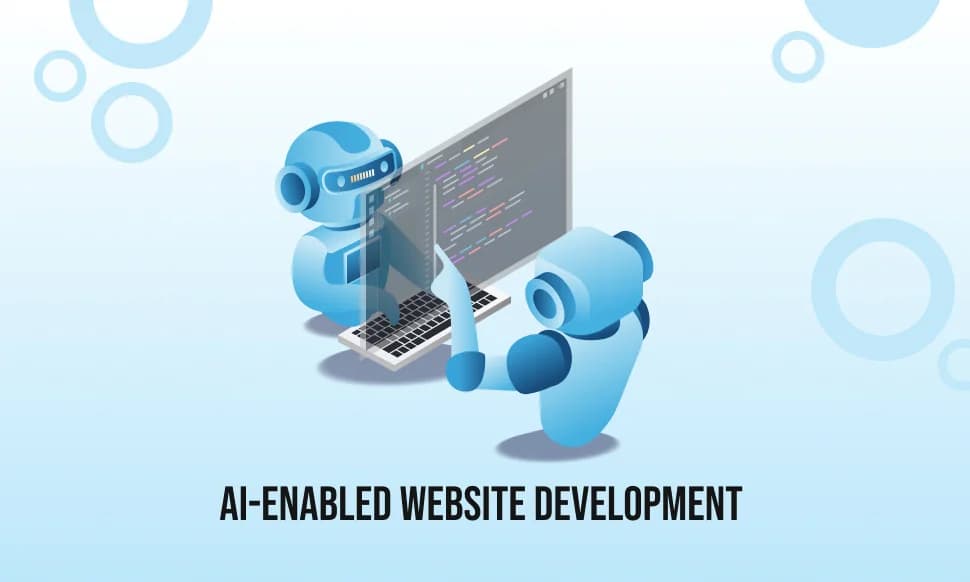
Every agency today claims to be AI-enabled. This guide cuts through the noise — covering the 5 real layers, honest cost ranges in India, and the exact questions to ask before you hire.
The Most Overused Phrase in Web Development Right Now
If you've talked to three web development agencies in the last six months, at least two of them called themselves an 'AI-enabled' company. If you've visited five agency websites recently, at least four of them have 'AI' in their service list.
And if you asked any of them to explain exactly what that means for your website — most gave you an answer somewhere between vague and meaningless.
Here's the reality: putting ChatGPT in a chatbot widget and calling your development practice 'AI-enabled' is not AI-enabled website development. It's a plugin installation. The difference between that and a genuinely intelligent website is about as large as the difference between a calculator and a data analyst.
AI-enabled website development means building systems where your website actively uses data — user behaviour, context, intent signals — to make decisions in real time. Not just display content. Make decisions.
This guide is for business owners, marketing heads, and CTOs who want to cut through the noise and understand what they're actually buying — and what they should be asking for.
New to AI in web development? Start here →
The AI Advantage: How AI Can Be Used to Revolutionize Website Development
What an AI-Enabled Website Actually Does (Vs. a Normal Website)
A traditional website is static in its logic. Everyone who visits sees roughly the same experience. The navigation is the same. The CTAs are the same. The content order is the same. The only personalisation is if you're logged in and it knows your name.
An AI-enabled website makes the experience dynamic based on real signals:
- A B2B visitor arriving from LinkedIn sees a case study relevant to their industry in the hero section — not a generic 'we build digital products' headline
- A return visitor who previously looked at pricing sees a comparison table on their second visit, not the same top-of-funnel introduction
- A visitor on a slow 4G connection gets a performance-optimised version of the page that loads key content first
- A visitor who's spent 4 minutes on your services page gets a contextually timed chat prompt — not a popup after 5 seconds
- Search terms that drove the visitor to your site adjust which content the page leads with
These aren't futuristic features. They're live and implementable today. The question is: does your website do any of them? And is the agency you're talking to actually capable of building them — or just talking about them?
The 5 Real Layers of AI in Website Development
Layer 1: AI-Personalised Content
The website changes what it shows based on who's viewing it. This ranges from simple segment-level personalisation (showing different hero content to enterprise vs. SMB visitors) to dynamic content blocks that adapt based on browsing history, referral source, and on-site behaviour.
Implementation requires: a CMS that supports conditional content, some form of visitor identification or segmentation logic, and either a rules-based or ML-powered decision layer. Cost: ₹3-15L to implement properly depending on complexity.
Layer 2: AI Chatbots and Conversational Interfaces
Not a scripted chatbot that asks 'Are you looking for A, B, or C?' — but an LLM-powered conversational interface that understands natural language, answers questions about your product from your actual documentation, qualifies leads intelligently, and escalates to humans with context.
The bar for this has risen dramatically in 2026. Users are now interacting with GPT-4 and Claude daily. A rule-based chatbot that can't understand a naturally phrased question feels broken. Your AI chatbot needs to actually understand language. Cost: ₹2-8L depending on knowledge base size and integration depth.
Layer 3: Intelligent Search
For content-heavy sites, e-commerce, or knowledge bases: natural language search that understands intent rather than exact keywords. 'Show me options for a small team under ₹10,000 a month' should return relevant results even if your product pages don't contain those exact words.
This is powered by vector embeddings and semantic search — technology that's now accessible at Indian business scale. Cost: ₹2-10L to implement.
Layer 4: AI-Powered Analytics and Recommendations
Moving from descriptive analytics ('here's what happened') to predictive analytics ('here's what will happen and here's what to do about it'). AI analyses conversion paths, identifies segments most likely to convert, recommends content optimisations, and flags pages with UX problems before your team manually discovers them.
This layer makes your marketing team dramatically more productive — they work on what matters instead of digging through dashboards. Cost: ₹2-6L to set up the right analytics infrastructure.
Layer 5: AI-Generated and AI-Optimised Content
Not replacing your content team — extending their capacity. AI assists with generating first drafts for product descriptions, localising content for different Indian markets, generating FAQs from your support ticket data, and optimising existing content for search and readability automatically.
The key word is 'assists.' AI-only content without human review and brand voice alignment creates content that's technically complete but tonally wrong. The best implementations treat AI as a first-draft machine that humans then craft into final content.
See this in action for a real industry →
The Future of Chemical Websites: AI, Automation, and Smarter Buyer Journeys
The Real Cost of AI-Enabled Website Development in India
These are build costs. Running costs (LLM API calls, compute, analytics infrastructure) vary by usage volume — plan for ₹15,000-₹1,00,000/month depending on traffic and feature depth.
What Real AI-Enabled Development Looks Like at 12Grids
For UPL — a Fortune 500 agro-chemical company with a web presence across 130+ countries — we built an AI-enabled content management layer that allowed regional teams to generate localised, contextually relevant content for different geographies without going through a central content team for every update.
For e-commerce clients, we've implemented AI-powered product recommendation engines and WhatsApp-integrated chatbots that handle 60-70% of customer queries without human intervention.
Our approach: we don't add AI features because they sound impressive. We identify the specific conversion or operational problem an AI layer will solve, build the minimum viable version of that layer, measure the impact, and scale what works.
The companies getting real ROI from AI websites aren't the ones that added the most AI features. They're the ones that identified the one or two specific places where intelligent automation creates genuine business value.
5 Questions to Ask Any 'AI-Enabled' Agency
- What AI feature have you built — not used as a tool, actually built and integrated into a production website?
- Can you show me a before/after on a metric (conversion rate, engagement, support volume) from an AI integration you did?
- How do you handle AI errors or hallucinations in a customer-facing context?
- Who owns the AI model and data — us or you?
- What's the ongoing cost of the AI infrastructure after launch?
Ready to work with an agency that actually builds this? →
Website Development That Works as Hard as You Do
Ready to Build a Website That Actually Works Intelligently?
We'll audit your current site, identify the 1-2 AI integrations with the highest ROI for your specific business, and give you a clear build plan. No buzzwords. No unnecessary complexity.
→ Book a Free Consultation: Here
→ Email: sales@12grids.com | +91 91379 97497

Kailash Vele
I lead the technology vision and architecture across all our products and client solutions — ensuring that innovation, scalability, and reliability are at the heart of everything we build. From Laravel to AI-powered systems, I work closely with our teams to implement frameworks that are not just functional, but future-ready. At 12Grids, I’m focused on driving engineering excellence, building clean and modular systems, and aligning our tech stack with business goals. Whether it’s launching a SaaS product, streamlining development workflows, or introducing automation for faster delivery, I believe great tech is built when structure meets speed. My core mission: to turn ideas into robust digital ecosystems that deliver real, measurable value.
Connect on LinkedInPut AI to work in your content engine
We design AI-native marketing workflows that ship - not demos.


Get the good stuff, monthly.
One thoughtful email a month - new research, playbooks, and ideas. No noise.