



Web Development
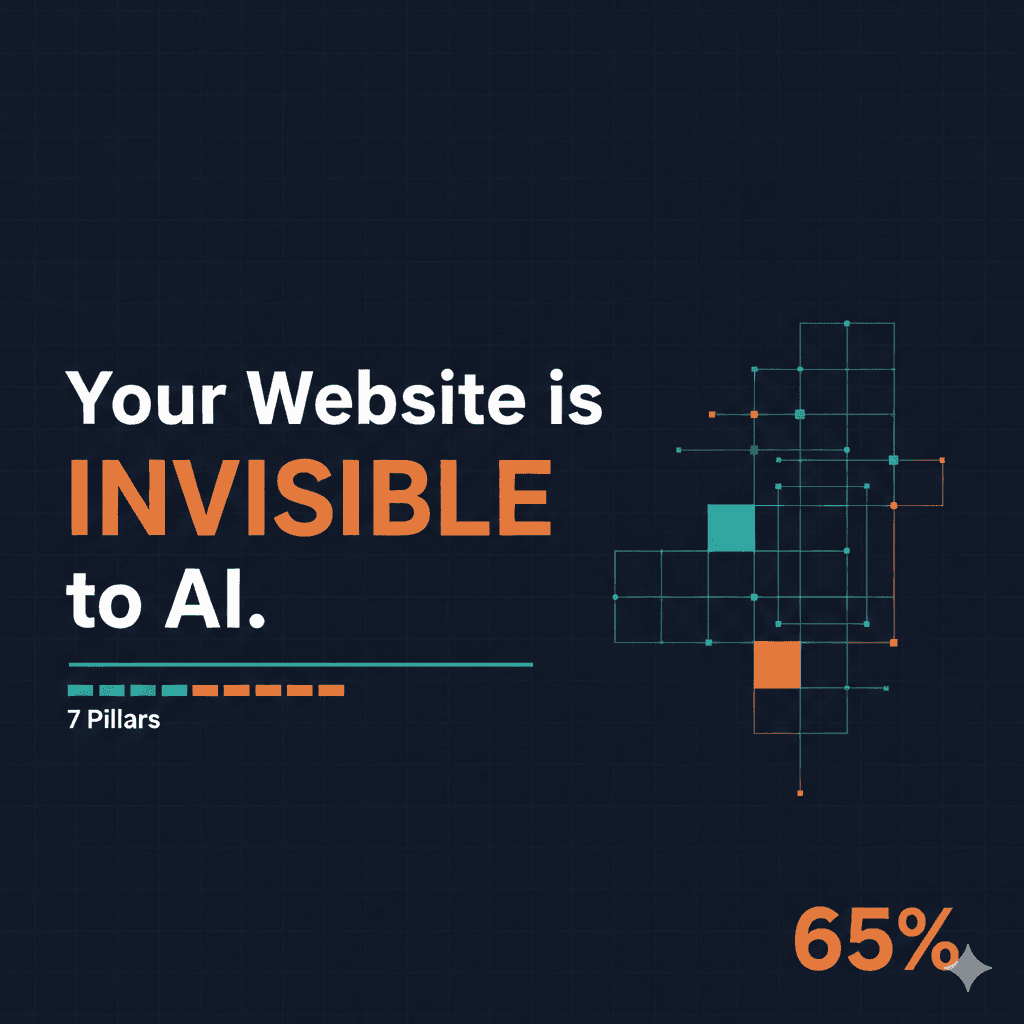
Your Website is Invisible to AI - Here's the 7 Pillar Fix (2026 Guide)
10 mins | 18 Feb 2026
I want to tell you about a conversation that changed how I think about websites.
It was a Tuesday. Late afternoon. I was sitting in the conference room of a specialty chemicals company in Mumbai — around INR 200 crore in revenue, been around 15 years, recently spent a decent chunk of money redesigning their website. The site looked sharp. Good product pages. Solid Google rankings for their core terms. The marketing head was proud of it, and honestly, he had reason to be.
Then I did something nobody had thought to do. I pulled out my phone, opened ChatGPT, and typed in the exact query their buyers would use: "best plasticizer suppliers for food-grade PVC in India."
Nothing. Their name did not come up. Not in the answer, not in the sources, nowhere.
Tried Perplexity. Same story. Pulled up Google's AI Overview — and there, sitting comfortably in the recommendation, was a competitor half their size with half their product range.
The room went dead quiet.
"But we rank on Google," the marketing head said.
I remember my exact words: "You rank on old Google. The new one doesn't know you exist."
That was the moment it clicked — for them and for me. We had been thinking about websites wrong. All of us. The question is no longer "does your website rank?" The question is: can AI find it, read it, understand it, and
trust it enough to recommend you?
If you run a business or lead an IT team, there is a strong chance your website has this exact blind spot. Let me walk you through where the gaps typically are — and more importantly, what actually fixes them.
Something Fundamental Has Shifted
I will keep the numbers brief because the point is obvious once you see it.
More than six out of ten searches now end without anyone clicking a link. People ask ChatGPT, Perplexity, or Gemini, get a synthesized answer, and move on. Gartner thinks a quarter of all organic traffic will redirect to AI chatbots by next year. AI-referred traffic to websites grew over 350% in the past twelve months alone.
Your website was designed to compete in a list of ten blue links. That list is shrinking. What's replacing it is a single AI-generated answer — and either your business is in that answer or it is not.
Through our work across manufacturing, chemicals, SaaS, and professional services, we have identified seven layers that determine whether a website is genuinely AI-ready. I will walk through each.
1. AI Indexability — You Have New Visitors and They Are Not Human
Here is something most IT teams have not confronted yet: there is a new generation of bots crawling your website. GPTBot from OpenAI. ClaudeBot from Anthropic. PerplexityBot. Meta-ExternalAgent. And your robots.txt file — that tiny text file most people set up once and forget — decides whether these bots can see anything on your site.
Rough estimate? About one in five of the world's top websites have bothered to configure rules for these crawlers. Among mid-market Indian companies, the number is close to zero.
Three things matter right now.
First — update your robots.txt. Explicitly permit GPTBot, ClaudeBot, PerplexityBot, and OAI-SearchBot. If you have not added these, your site may be blocked by default and you would never know.
Second — look into something called llms.txt. It is a new file format, still early days, that works like a sitemap built specifically for AI. Instead of listing every page on your site, it provides a curated summary of your most valuable content in a structure that language models can parse quickly. Anthropic uses it. So does Cursor. Most of your competitors have never heard of it. That is your window.
Third — and I cannot stress this enough — check how much of your important content depends on JavaScript to render. Product specifications hidden behind tabs. Pricing loaded dynamically. Technical data inside interactive widgets. Most AI crawlers do not execute JavaScript. If the content is not in the raw HTML, they cannot see it. Period.
Server-side rendering is not a developer preference anymore. It is a visibility decision.
2. Answer Engine Optimization — The New SEO Layer
There is a new discipline taking shape called AEO — Answer Engine Optimization. Forget the jargon for a moment. The concept is dead simple: it is about making your content worthy of being cited when an AI writes an answer.
Here is the part people miss. ChatGPT does not have some magical separate index. For most queries, it searches Google first, reads the top results, then generates its answer with citations that roughly follow the same ranking order. So traditional SEO still matters — it is the base. AEO is the layer on top that determines whether AI actually pulls from your page or skips it.
What I have seen work in practice comes down to five things.
Build your content around entities, not keywords. AI does not think in keywords. It maps relationships between concepts. Structure your site in topic clusters — one main page connected to supporting articles around a core idea.
Write headings as questions. Not "Our Manufacturing Process" but "How Does [Company] Manufacture Food-Grade Plasticizers?" Then answer the question directly in the first two or three sentences before going deeper.
Implement structured data. I know this sounds technical, but here is the business case: pages with proper JSON-LD schema markup get cited by AI roughly 30–35% more often. FAQPage schema, Article schema with author credentials, Product schema for your catalog — these are no longer nice-to-haves.
Make your expertise visible. Author bios with real credentials. Publication dates on every article. Citations when you reference data. Case studies drawn from actual projects. Google calls this EEAT — Experience, Expertise, Authoritativeness, Trustworthiness. AI systems use the same trust signals.
Publish consistently. This surprised me when I first saw the data, but LLM citations spike within two to three days of content going live and drop off fast within a month or two. If you publish a great article and then go silent for six months, the window closes. Two to four solid pieces a month with regular updates to existing content is the rhythm that sustains visibility.
3. AI Chatbots — Because Contact Forms Are a 3% Game
Let me put a number on the problem. The typical B2B contact form converts at two to three percent. That means 97 people out of every 100 who visit your website leave without doing anything. You spent money getting them there — through SEO, ads, referrals — and 97% vanish.
AI chatbots flip this. Not the old rule-based ones that feel like navigating a phone tree. I mean AI-native chatbots trained on your actual product data — specs, pricing, documentation, case studies — that can hold a real conversation.
The results are hard to argue with. Companies using them see conversion rates jump by roughly two-thirds. And each interaction costs a fraction of what a human agent does.
We built a prototype for an industrial client where the chatbot was trained on their entire product specification library. Buyer support time dropped by 60%. But more importantly, the quality of enquiries that reached the sales team went up because the chatbot had already done the qualifying. The sales team stopped wasting time on tyre-kickers and started spending it on serious buyers who arrived with context.
The architecture matters: knowledge base integration, CRM that receives every conversation, behavioral triggers that start the chat proactively (when someone visits the pricing page three times, that is a signal), and clear escalation paths to human agents for complex queries.
4. AI-Powered Lead Generation — Active Pipeline, Not Passive Forms
89% of B2B visitors browse and leave. The traffic is not the issue. The conversion architecture is.
Conversational lead capture — where an AI chatbot gathers information through natural dialogue — produces roughly four times more leads than a static form sitting in your sidebar. Why? Because "Shall I email you the pricing breakdown?" is a fundamentally different experience from "Please fill in your name, email, company, phone number, and message."
The real power, though, is in what happens after capture. AI scores every visitor in real time based on their behavior — which pages they visited, how long they stayed, whether they came back, what they downloaded. Hot leads go straight to sales with full context. Warm leads enter automated nurture sequences. Cold leads get tagged for re-engagement later.
For IT leaders evaluating this: the integration layer is what makes or breaks the entire system. If the chatbot captures a lead but your CRM does not receive the conversation context, buying signals, and behavioral data automatically, you have built a slightly fancier form. Not a pipeline engine.
5. Hyper-Personalization — Same URL, Different Experience
Here is a stat that should make you uncomfortable if your website shows the same page to everyone: 77% of B2B companies using hyper-personalized digital experiences grew their market share, according to McKinsey. Some gained more than ten percent.
What does this look like? A procurement head from the pharma industry lands on your homepage and sees case studies from pharma, messaging about compliance and GMP standards, and a CTA for a regulatory-focused consultation. A plant manager from automotive hits the same URL and sees manufacturing throughput case studies, technical spec comparisons, and a chatbot opening with a question about production volume.
Same website. Entirely different experience. Driven by AI reading visitor signals — IP-based firmographic data, referral source, browsing behavior, return visit patterns — and adapting in real time.
Most B2B websites today are at what I call Level 0: static. Everyone sees identical content. Even moving to Level 2 — where content adapts based on individual browsing behavior — creates a compounding advantage that gets harder for competitors to close over time.
6. The AI-Enabled Buyer Journey — Connected, Not Fragmented
A typical B2B purchase involves 6 to 10 people and takes weeks. 80% of the interactions happen digitally. And here is the kicker — 89% of those buyers are already using AI tools like ChatGPT during their research process.
Your buyers are using AI. Your website is not. That asymmetry is where deals get lost.
An AI-enabled journey connects every stage into one intelligent flow: discovery through AI search visibility, engagement through chatbot conversations, education through personalized content paths that adapt to what the buyer has already consumed, evaluation through comparison tools and calculators, conversion through forms pre-populated with browsing context, and post-sale nurturing through predictive recommendations.
Think of it this way. A brochure website shows information and hopes the buyer figures out the next step. An AI-enabled website reads the buyer's signals and guides every decision.
7. AI Analytics — Stop Staring at Dashboards, Start Predicting
Most companies I work with are still running on what I call "rearview mirror analytics." Dashboards that tell you what happened yesterday. Page views went up. Bounce rate went down. Great. Now what?
AI-powered analytics answers a different question: what is about to happen, and what should you do about it?
Predictive lead scoring tells you which of today's visitors are most likely to become tomorrow's customers. Anomaly detection flags unusual patterns before your team notices. Content attribution maps which specific articles influenced closed revenue — not just traffic, but deals. And natural language querying lets anyone on your team ask "which landing pages converted best from LinkedIn traffic last quarter?" without building a custom report.
For IT heads mapping a roadmap: Level 1 is basic GA4. Level 2 connects analytics to your CRM with proper conversion events. Level 3 adds predictive models and automated alerts. Most companies are stuck at Level 1. Even reaching Level 2 — just connecting your analytics to your sales pipeline — changes the quality of decisions across the organization.
Where to Start — A 90-Day Sequence
You do not need all seven pillars at once. But the order matters.
First 30 days: fix what AI cannot see. Audit robots.txt. Deploy structured data on your top 20 pages. Build an llms.txt file. Rewrite five key content pages with question-forward headings and clear, direct answers in the opening lines.
Days 31 to 60: make the website intelligent. Deploy an AI chatbot trained on your product knowledge. Replace or supplement your contact form with conversational capture. Connect everything to your CRM so leads arrive with context, not just contact details.
Days 61 to 90: optimize the experience. Add behavior-based personalization — even basic industry or referral-source adaptation makes a difference. Connect analytics to your CRM. Start a publishing rhythm of two to four AEO-optimized pieces per month.
Companies that build this infrastructure now create advantages that get harder to replicate with every passing quarter. The shift is already underway. The only question is whether your website is built for what comes next — or still optimized for a search engine that no longer works the way it used to.
This article draws from research and frameworks in The AI-Ready Website Playbook — a detailed strategic guide with implementation checklists, maturity scorecards, and a 70-point self-audit tool. Get your copy here.
12Grids is a strategy-led digital solutions company. We help businesses design and build websites that drive discovery, leads, and revenue in an AI-driven world.
Author

Ravindra Warang
Director - Strategy
Share
Share
Related
_desktop_list_webp_d12ff3cb.webp&w=640&q=75)
Web Development
How Much Does AI Website Development Cost in India 2026 Real Numbers | Every Feature Priced
15 mins : 22 Apr 2026

Web Development
How to Build an AI-Powered E-commerce Store in India : What Actually Increases Sales (2026 Guide)
9 mins : 15 Apr 2026

Web Development
AI Chatbot for Your Website & WhatsApp:The Complete Buying Guide for Indian Businesses (2026)
8 mins : 09 Apr 2026
Other Articles

Web Development
AI-Enabled Website Development in India: What It Actually Means, What It Costs, and What to Avoid
9 mins : 31 Mar 2026

Web Development
Custom Website vs. WordPress vs. Shopify:What Indian Businesses Actually Need
8 mins : 30 Mar 2026
Web Development
Frictionless Checkout: Why Simplicity Wins Every Time?
5 mins : 18 Sept 2025