_desktop_list_webp_cf6f183b.webp&w=640&q=75)



UI/UX
AI-Powered UX Design : How to Build Digital ProductsThat Learn From Your Users
9 mins | 17 Apr 2026
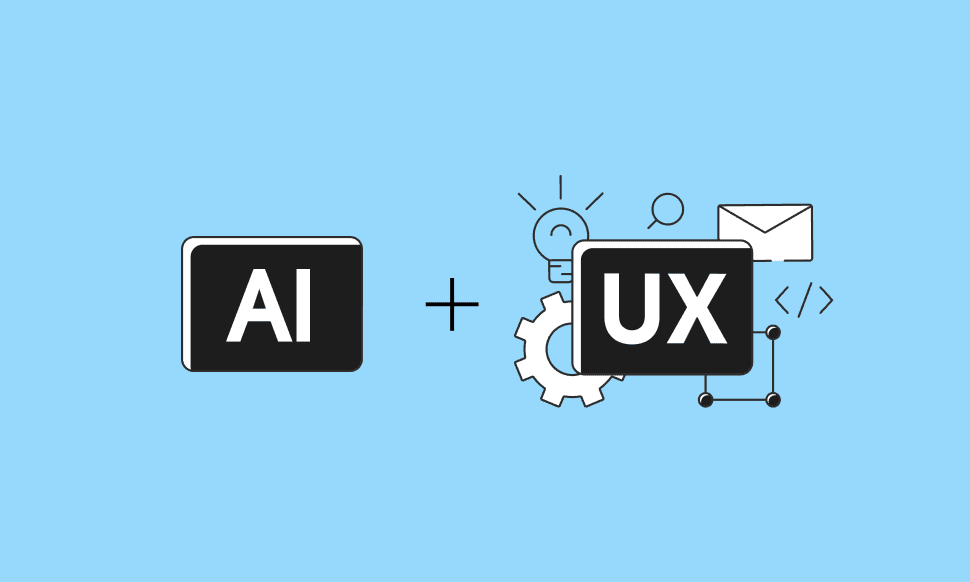
The Design That Changed Based on What Users Did
Most websites are designed once, launched, and then left largely unchanged until a major redesign. The design team made decisions in a workshop, the assumptions were baked into the layout, and user feedback arrives slowly via support tickets and occasional surveys.
AI-powered UX design breaks this cycle. Instead of designing once and hoping you were right, you design an intelligent experience that observes how users actually behave, identifies where the design assumptions were wrong, and adapts — either automatically or by giving designers precise, actionable data to act on quickly.
Traditional UX design is a hypothesis. AI-powered UX design is a living experiment that continuously validates and refines that hypothesis based on real user behaviour.
What AI Actually Changes in the UX Design Process
AI in Research — Finding Patterns Humans Miss
Traditional user research involves interviews, surveys, and session recordings — analysed manually by a researcher. AI changes this at two levels:
First, AI tools can process thousands of session recordings and identify patterns in where users struggle, where they show hesitation, and where they abandon — at a scale no human researcher can match. Instead of watching 20 sessions and extrapolating, you're seeing patterns across 2,000 sessions and identifying statistically significant friction points.
Second, AI analysis of support ticket data, chat transcripts, and user feedback can surface UX problems that users are articulating in support requests but haven't been connected to specific design elements. 'Users keep asking how to find X' is a navigation problem — but connecting that observation to the specific page and flow that's causing it requires analysis that AI can automate.
AI in Testing — Continuous Validation
Traditional A/B testing requires: hypothesis formation, variant design, statistical sample size calculation, waiting for results, analysis, and decision. This cycle takes weeks per test.
AI-powered multivariate testing can run dozens of simultaneous experiments, adjust traffic allocation dynamically based on interim results (sending more traffic to winning variants automatically), and identify winner combinations faster. What took 3 months of sequential testing can happen in 3 weeks with properly configured AI testing infrastructure.
AI in Personalisation — Individual-Level Design
The most significant AI contribution to UX is the ability to make the designed experience adaptive at the individual level. Not 'we designed one experience and everyone gets it' — but 'we designed an intelligent system that serves different experiences to different users based on who they are and what they're trying to do.'
For UX designers, this means designing systems rather than screens — creating the rules and logic that govern how the experience adapts, rather than a single fixed layout.
AI in Accessibility — Automated Compliance
AI tools can now scan designs and interfaces for WCAG accessibility violations, colour contrast issues, touch target sizes, and readability problems — at the component level during design, rather than as a post-launch audit. This embeds accessibility into the design process rather than treating it as a final checkpoint.
Wondering how AI changes not just design but the entire website you build around it?
→ Read: AI-Enabled Website Development in India — What It Actually Means
The 4 AI UX Design Tools That Change Our Process
Hotjar AI and Microsoft Clarity
Session recording with AI analysis. Instead of watching hours of recordings, AI surfaces: the specific moments where users rage-click, scroll confusion, and hesitation patterns. We use this in the optimisation phase of every project — the data consistently reveals friction we didn't anticipate in design.
Figma AI features
Automated component generation, design variant creation, and accessibility checking built into the design tool. Speeds up the design iteration process significantly — particularly for responsive design variants and design system expansion.
AI-powered analytics (GA4 + BigQuery)
Google Analytics 4's ML-powered insights automatically flag anomalies in user behaviour — pages that suddenly see higher exit rates, conversion funnels showing unexpected drops, audience segments behaving differently from the main cohort. These signals feed back into design decisions faster than manual analysis.
UserTesting AI synthesis
When user testing sessions are run, AI synthesis tools transcribe, tag, and summarise findings across sessions — reducing research synthesis time from days to hours. The designer gets a theme analysis, not just a pile of transcripts.
How AI UX Design Works in a Real Project
For a SaaS client's customer portal redesign, our AI-powered UX process worked like this:
- Session analysis across 3,000 existing sessions identified three navigation patterns that 60% of users went through before abandoning — each correlating with a specific information architecture problem
- Support ticket NLP analysis surfaced 'can't find X' as the most common phrase across 800 tickets — mapped to the same navigation problem
- Designed three alternative navigation structures, ran simultaneous A/B/C test with AI traffic allocation
- Winning variant identified in 11 days (vs. estimated 6 weeks with traditional A/B testing)
- Personalisation layer added: users with enterprise job titles (detected via company intelligence) saw enterprise-relevant use cases first; SMB users saw simplified onboarding
Net outcome: task completion rate improved 34%, average session duration increased 52%, support tickets related to navigation fell 61%.
What AI-Powered UX Design Is Not
It's worth being direct about what this isn't:
- It's not AI replacing UX designers. The intelligence a trained designer brings to understanding a business problem, empathising with users, and making holistic design decisions is not replaceable. AI handles scale, speed, and pattern recognition. Designers handle judgment, strategy, and creativity.
- It's not a substitute for user research. AI analyses behavioural data — it tells you what users do, not why. Understanding why requires human conversation with actual users.
- It's not a shortcut to good design. AI tools can help you iterate faster and validate more rigorously. They can't help you if the initial design thinking is fundamentally wrong.
Now that you know what AI-powered UX design actually is,
the next question is who to trust with it.
→ Read: How to Choose a UI/UX Design Agency in India Without Getting Burned
Frequently Asked Questions
1. What is AI-powered UX design?
AI-powered UX design uses artificial intelligence tools to analyse how real users behave on a product — and then uses those insights to improve the design continuously. Instead of designing once and hoping it works, the experience is built to learn, adapt, and get better over time based on actual usage data.
2. How is AI UX design different from traditional UX design?
Traditional UX design is built on research, assumptions, and periodic updates. AI-powered UX design runs continuously — testing, personalising, and surfacing friction points at a scale no human team can manually match. The biggest difference is speed and precision: patterns across thousands of sessions, not guesses from twenty.
3. How does AI powered UX design work for product teams in India?
AI powered UX design for product teams in India typically starts with behavioural analysis — understanding how real users move through your product. From there, it covers continuous testing, personalisation, and accessibility checks. The result is a product that improves after launch, not just at launch.
4. What does data-driven UX design actually mean in practice?
It means design decisions are backed by real user behaviour data — not just stakeholder opinions or designer instincts. In practice, this looks like: session analysis identifying where users drop off, A/B tests validating which layout works better, and support ticket analysis revealing navigation problems before a redesign even begins.
5. Which AI UX design company in India should product teams work with?
Look for a company that combines experienced UX designers with actual AI tooling — session analysis, multivariate testing, and personalisation infrastructure. 12Grids is a Mumbai-based AI UX design company in India working with SaaS, e-commerce, and enterprise product teams.
Ready to build a product that works for real users?
We research, design, and test,
so your product does not just look good, it actually works.
Want UX Design That Keeps Getting Better After Launch?
We combine experienced UX design with AI-powered analytics and testing infrastructure — so the product you launch improves continuously based on real user behaviour, not assumptions.
→ Email: sales@12grids.com | +91 91379 97497
Author

Kailash Vele
Director - Technology
Share
Share
Related
_desktop_list_webp_2325ad4d.webp&w=640&q=75)
UI/UX
How to Choose a UI/UX Design Agency in India(Without Getting Burned)
8 mins : 23 Mar 2026

UI/UX
UX Audit: How to Know Your Website Is Losing Customers(And Exactly How to Fix It)
7 mins : 17 Mar 2026

UI/UX
How UPL Built a Unified Digital Identity Across 140 Countries – And What Brands Can Learn From It
3 mins : 26 Nov 2025