




Web Design
How We Built a Digital Ticketing System for Mumbai Zoo— A Government Case Study
7 mins | 20 Mar 2026
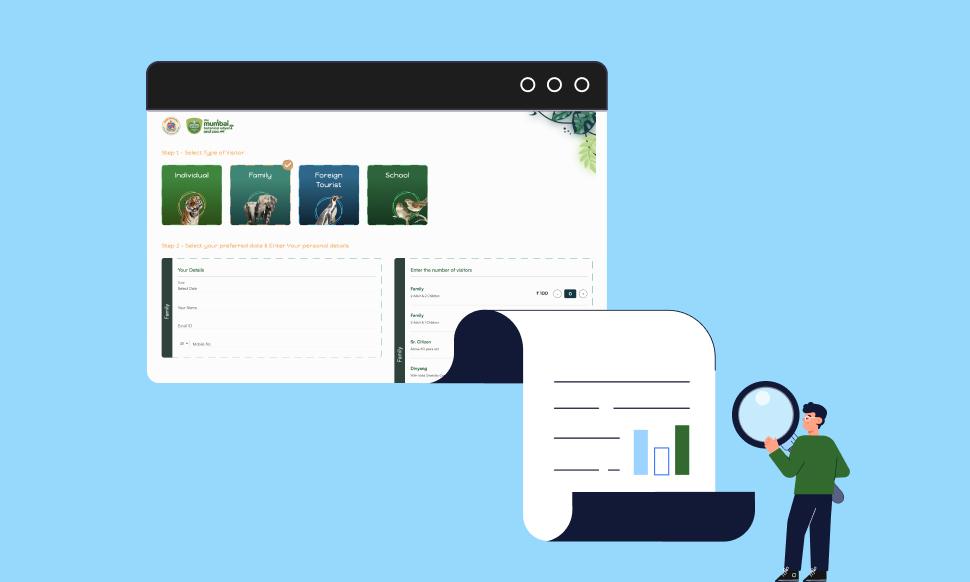
The Brief That Sounded Simple
'We need an online ticketing system for the zoo.'
That's how the brief started. And on the surface, it sounds like a fairly standard project. Build a checkout flow. Connect a payment gateway. Generate a ticket. Done.
Except when you actually understand the context — who the users are, where they're coming from, what the physical experience looks like, what happens if the system goes down — the project becomes something completely different.
Mumbai Zoo (Byculla Zoo, formally known as Jijamata Udyan) is one of Mumbai's oldest and most visited public spaces. It draws thousands of visitors daily — families on weekends, school groups on weekdays, senior citizens on mornings. The visitor demographic is genuinely diverse: affluent families from South Mumbai with iPhones, working-class families visiting from the suburbs with entry-level Android phones on 2G connections, elderly visitors navigating smartphones for the first time, and school groups of 40 children where a single teacher is managing tickets for everyone.
A generic ticketing platform built for tech-savvy urban users would have failed 60% of this audience on day one.
This is the story of how we approached a public-sector digital transformation project — and the lessons that apply to any business serving diverse users at scale.
Step 1: We Visited the Zoo Before We Opened Figma
This is the part that most agencies skip.
Before writing a single line of code or sketching a single wireframe, our team spent two days at the zoo. Not as designers with clipboards — as observers. We watched how visitors moved through the ticketing process. We noted where people got confused at the physical counter. We spoke to ticket staff about the most common complaints and mistakes. We counted how many people were using cash vs. card. We checked the network signal strength inside the zoo.
What we found shaped every decision that came after:
- Many visitors — especially elderly ones — would type the wrong number of tickets and not notice. The checkout needed large, clear quantity selectors with running total displays.
- Network connectivity inside the zoo was poor in some areas. QR tickets needed to work offline, scanned by staff without requiring an internet connection at the point of entry.
- The payment failure rate for unfamiliar payment methods is high for non-tech users. The UX needed to guide people through UPI/card payment step by step, not assume prior knowledge.
- Group bookings (school parties, corporate visits) were manually handled and took 15-20 minutes at the counter. This was a clear automation opportunity.
- Multiple languages were needed. Marathi-speaking visitors found English-only interfaces intimidating.
Step 2: The Architecture Decisions That Made It Work
Most consumer ticketing platforms are built to run on fast urban internet. We had to build one that worked across the full spectrum of connectivity.
Progressive Web App approach
We built the ticketing interface as a progressive web app — accessible from any browser, no app download required. This removed a significant adoption barrier for users who were reluctant to install another app on their phones. It also meant updates could be pushed without app store approval cycles.
Offline-first QR validationObserve real users
We designed the ticket validation system so zoo staff could scan QR codes from a cached list of valid tickets, even without real-time internet. Tickets were synced when connectivity resumed. This prevented the scenario where a payment gateway outage or connectivity issue at the gate stranded visitors with valid tickets they couldn't use.
Simplified 3-step checkout
Standard e-commerce checkouts have 6-8 steps. We engineered ours to 3: select tickets + visitors, enter phone number, pay. The phone number (rather than email) served as the receipt delivery channel, since WhatsApp and SMS penetration is near-universal even among low-tech users.
Admin dashboard for zoo management
Beyond the visitor-facing experience, zoo administrators needed real-time visibility into daily bookings, capacity, and revenue. We built an admin panel that gave the operations team live dashboards, booking management, and report exports — reducing their manual record-keeping overhead significantly.
Kiosk compatibility
The same codebase served the kiosk interface at the zoo entrance — with a different UI layer optimised for touch on large screens. This meant a single system to maintain rather than two separate platforms.
The Results
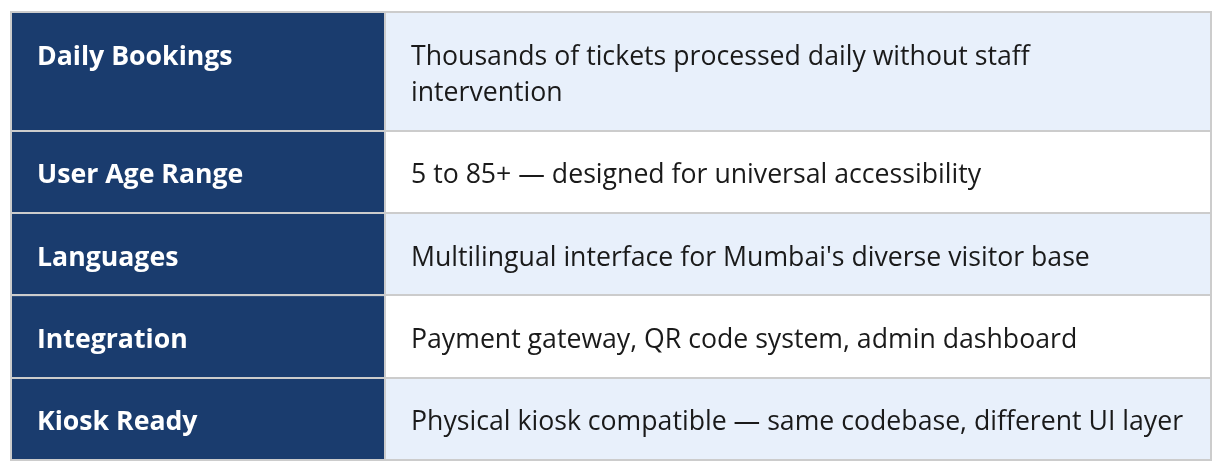
The most meaningful result: zoo staff who previously spent their entire shift manually processing tickets could now focus on the visitor experience — answering questions, helping with directions, managing the space.
What Government & Public Sector Projects Taught Us
We've now delivered digital solutions for multiple government bodies — Mumbai Zoo, CSMVS Museum (kiosk ticketing), BMC Swimming Pools (booking system), and government enterprise clients like UPL. Each project taught us something that private sector clients rarely encounter:
Accessibility is not optional — it's the baseline
In private sector projects, accessibility is often treated as a nice-to-have. For government-serving platforms, it's the baseline requirement. When your user base genuinely includes citizens of every age, ability, and tech literacy level, inclusive design is the product requirement, not an add-on.
Reliability > Features
Private sector clients often want more features. Government clients want the existing features to never fail. Uptime, graceful error handling, offline capability, and clear error messages matter more than having five payment methods if none of them work reliably when the network is unstable.
Security is non-negotiable
A government ticketing system processes real money and personal data for citizens. Government-grade security requirements shaped our architecture decisions from the database design up. Secure APIs, encrypted data at rest and in transit, and proper admin access controls aren't things you add at the end — they have to be built in from the start.
Procurement complexity is real — plan your stakeholder communication
Government projects involve more stakeholders than private sector work. Decisions require approvals. Requirements can change between tender, award, and build. Our project management approach adapted: more documentation, clearer change request processes, and regular stakeholder reviews rather than assumptions that one meeting equals sign-off.
Lessons That Apply to Any Business Serving Diverse Users
You don't need to be a government project to learn from this work. Any business with a broad user base — healthcare, financial services, consumer apps, education — faces the same challenge:
- The user you design for is not always the user who shows up. Observe real users before you design for imagined ones.
- Offline-first thinking makes products more resilient everywhere. Even premium users experience bad connectivity.
- Simplification is harder than feature-addition. Reducing a 7-step checkout to 3 steps took more iteration than building the 7-step version.
- Accessibility investments pay for themselves. When the experience works for your least tech-savvy user, it works better for everyone.
Can 12Grids Help Your Organisation?
We work with government departments, public sector undertakings, and enterprises whose products serve diverse Indian audiences. Our experience with MCGM, BMC, and CSMVS means we understand the operational, procurement, and technical realities of public sector digital transformation.
We also apply these same principles to private sector clients — because whether you're a logistics company with field workers using your app, or a financial services brand serving Tier-2 and Tier-3 cities, the challenge of inclusive, reliable digital experiences is the same.
Exploring a Government or Enterprise Digital Project?
Let's talk about your requirements. We'll share our approach, relevant case studies, and give you an honest assessment of scope and timeline.
→ Contact Us: Here
→ Email: sales@12grids.com | +91 91379 97497
Author

Kailash Vele
Director - Technology
Share
Share
Related

Web Design
Polymers, Innovation, And A Modern Website: The Goldstab Organics Journey
5 mins : 10 Nov 2025

Web Design
From Friction to Finish Line: The God of Sports Digital Transformation
6 mins : 17 Sept 2025
Web Design
The Future Of Responsive Web Design: Emerging Trends, Innovations And Predictions In 2026
7 mins : 17 Feb 2026