





SEO
Product Engineering vs. Software Development:What Founders and CTOs Need to Know Before Hiring
5 mins | 09 Mar 2026
_e848d9a5.jpeg&w=2048&q=75)
Two Teams. Same Output. Completely Different Projects.
Two founders came to us in the same month with nearly identical requirements: both were building SaaS platforms for the Indian logistics sector. Same industry, similar feature sets, comparable budgets.
One came with a 40-page feature specification document. He knew exactly what he wanted built, in what order, to what spec. He wanted a software development partner who would execute.
The other came with a 4-page document describing his customer's problem, his hypotheses about what would solve it, and three outcomes he wanted to achieve in the first six months. He wanted a product engineering partner who would help him figure out what to build.
Eighteen months later: the first founder had a feature-complete product that his target customers didn't adopt because several core workflow assumptions were wrong. The second had a product with half the features — but three times the paying users.
Software development delivers what you specify. Product engineering helps you figure out what to specify in the first place — and then builds it.
Understanding this distinction is one of the most important decisions a founder or product leader makes when choosing a digital partner.
Defining the Terms
Software Development
Traditional software development is a service where a client provides requirements and a development team delivers working code. The agency's job is execution. Scope is defined upfront, changes are managed via change requests, and success is measured by delivering agreed features on time and on budget.
This model works well when requirements are genuinely stable and well-understood — enterprise internal tools, system migrations, custom integration work. It struggles when the product is new and the market hasn't validated whether the requirements are right.
Product Engineering
Product engineering combines product thinking, UX design, and engineering in an integrated loop. The team doesn't just build — they participate in defining what to build, prioritise based on user feedback, iterate rapidly, and measure outcomes rather than deliverables.
A product engineering team asks: 'Is this feature the right solution to the problem?' before they start building. A software development team asks: 'What are the specs for this feature?'
The difference sounds philosophical. The financial implications are very concrete.
Side-by-Side: The Difference in Practice
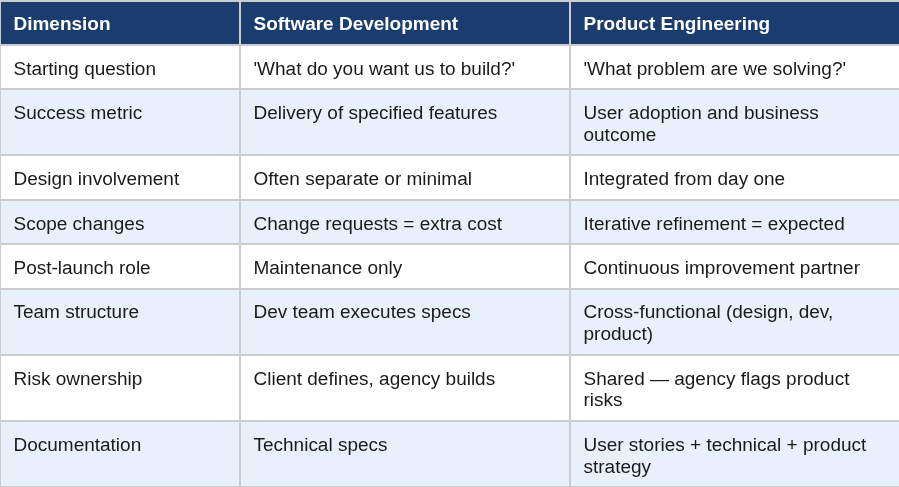
When You Need Software Development
Be honest with yourself about which model fits your situation:
- You have a well-understood internal tool or workflow to digitise and requirements are stable
- You're migrating from one system to another with known data and feature parity requirements
- You're building custom integrations between existing enterprise systems
- Your product is live, validated, and you need capacity to add well-defined features
- You have an in-house product team — you'll own the product thinking and need execution capacity
In these cases, a good software development partner who executes specifications reliably and communicates clearly is exactly what you need. Product engineering overhead (design sprints, user testing, product strategy discussions) would slow you down without adding value.
When You Need Product Engineering
- You're building a new product where market validation is still ongoing
- Your users are external customers whose behaviour you need to understand and influence
- You've already tried building something and it didn't get the adoption you expected
- Your competitive advantage depends on user experience, not just functionality
- You don't have a full-time product manager or UX designer in-house
- You're a startup or growth-stage company where pivoting quickly matters more than feature completeness
For most Indian startups and SaaS founders we work with, product engineering is the right model — especially in the first 18 months. The cost of building the wrong features is far higher than the cost of the additional design and strategy work that prevents it.
The Product Engineering Process — What It Actually Looks Like
Discovery and Problem Definition (Weeks 1-3)
Before any design or development: stakeholder interviews, user research (if users exist), competitive analysis, technical architecture planning, and defining measurable success criteria. This phase challenges the initial brief. Sometimes the result is 'your users actually need X, not Y.' Better to know in week 2 than in month 6.
Design and Prototyping (Weeks 3-8)
UX and UI design done in parallel with technical architecture. User testing of prototypes before a line of code is written. This is where assumptions get validated cheaply — a design prototype test costs a fraction of a code change after launch.
Iterative Development (Ongoing)
Two-week sprints with regular releases. Each sprint delivers working functionality that can be tested by real users. Priorities can shift between sprints based on what's learned. This is not the same as scope creep — it's intentional iteration within a defined product vision.
Measurement and Learning (Continuous)
Every release is instrumented. Usage data, conversion funnels, and user feedback inform the next sprint's priorities. The team acts on data, not assumptions.
The Hidden Cost of Getting This Wrong
Here's the financial reality that founders rarely discuss openly:
The average Indian SaaS startup we've talked to has rebuilt their core product at least once in the first three years. Sometimes twice. The primary reason is almost always the same: they built features users didn't need and left out features users actually required.
A full rebuild costs 60-80% of the original build cost, plus 6-12 months of lost time, plus the user churn and reputational cost of a product that didn't work.
A product engineering approach typically costs 20-30% more than pure software development in the first six months. This premium almost always pays for itself by preventing at least one major rebuild.
The founders who resist the product engineering premium are often the same ones who become our rescue project clients 18 months later.
What 12Grids Brings as a Product Engineering Partner
Our product engineering practice combines design, frontend, backend, and DevOps in a single integrated team — not siloed departments that hand off to each other. This matters because the most expensive problems in product development happen at the seams between design and development, and between development and deployment.
We've built and continue to develop our own products — Edge CRM, Pharma Now, God of Sports — which means we approach client products with founder empathy, not just engineering mindset. We know what it's like to own a product's metrics, not just its code.
For clients like Morphowiz (enterprise SaaS in the USA), the engagement required understanding complex enterprise workflows that their users deal with daily, translating them into an interface that non-technical users could navigate, and building a design system that could scale as the product grew. That's product engineering — not just software development.
How to Evaluate a Potential Product Engineering Partner
- Do they ask about your users before they ask about your features? (If the first question is 'what do you want to build?' — that's a software development shop)
- Can they show you a product they've built that changed a metric — not just a product they built?
- Do they have design capability integrated with their engineering team — or is design separate and optional?
- How do they handle situations where user research contradicts the client's initial brief?
- What does their sprint process look like, and how do clients stay involved between reviews?
- Do they have experience in your industry or adjacent ones — do they understand your users' world?
Building a Product That Needs to Actually Work for Users?
Let's start with a discovery conversation. We'll understand your product, your users, and your business goals — and tell you honestly whether you need software development or product engineering, and what the right engagement model looks like.
→ Start the Conversation: Here
→ Email: sales@12grids.com | +91 91379 97497
Author

Kailash Vele
Director - Technology
Share
Share
Related
SEO
Answer Engine Optimisation (AEO): How Indian BusinessesGet Found in ChatGPT, Perplexity & Google AI Search
8 mins : 04 Apr 2026
SEO
AI SEO vs Traditional SEO: What Indian Businesses Actually Need to Do in 2026
9 mins : 02 Apr 2026
%20Revised_desktop_list_webp_dd4e633e.webp&w=640&q=75)
SEO
llms.txt: What It Is, Why It Matters for Indian Businesses,and How to Create One Right Now
10 mins : 18 Mar 2026