



Project Management
How to Brief a Digital Agency: The Document That Saves Projects (Free Template Inside)
8 mins | 24 Mar 2026
_1fc535ab.jpeg&w=2048&q=75)
Why Most Projects Start Failing Before They Start
After 9 years and 520+ projects, we can often predict within the first meeting whether a project is going to go well or badly. It has nothing to do with budget, complexity, or which agency you choose.
It has everything to do with how clearly the client understands and communicates what they actually need.
The most expensive projects we've ever been called in to rescue shared one thing in common: they started with a vague brief. 'We need a website' or 'We want an app like Swiggy but for our business' or 'We want something modern and clean.' These phrases feel like direction. They're actually the absence of it.
A vague brief is not a starting point. It's an open invitation for the agency to build what they think you need — which is often not what you actually need.
The solution isn't complicated. It's a clear, structured brief. And you don't need to be a tech expert to write one. You need to be clear about your business, your users, and what success looks like.
This guide gives you the framework. The free template at the end gives you the document.
What a Good Brief Does
A good project brief does three things:
- It forces you to think through what you actually need — the process of writing it reveals assumptions you didn't know you were making.
- It gives agencies accurate information to scope and price the work correctly — fewer surprises, more accurate timelines.
- It becomes the reference document for the project — when 'what we agreed' becomes a dispute, a clear brief settles it.
We've seen a single well-written brief save a client ₹5 lakhs in scope change costs. We've also seen the absence of one cost a client 6 months of delay and a complete rebuild.
The 8 Sections Every Digital Brief Needs
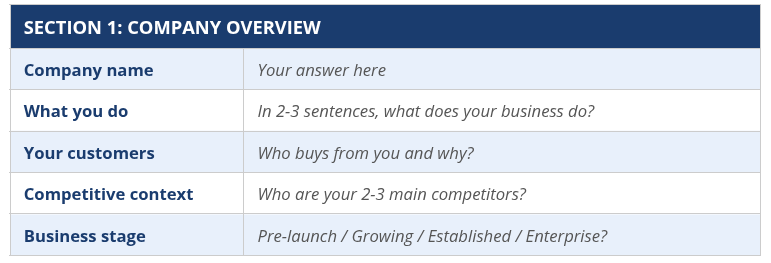
Section 1: Company and Context
The agency you're briefing doesn't know your business. Give them the context they need to make good decisions.
Include: what your company does, who your customers are, what makes you different from competitors, and any important business context (Are you in a regulated industry? Are you pre-launch or established? Are you targeting a specific city or national?).
What most people miss: the business context behind the project. 'We're launching this because our existing website was built 5 years ago and our sales team says prospects can't find what they need' tells an agency far more than 'we need a new website.'
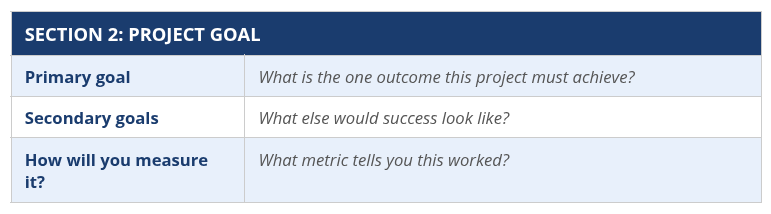
Section 2: The Project Goal
One sentence. What is the primary outcome this project needs to achieve?
Not: 'a website that looks professional and has good UX.' That's a description, not a goal.
Goal: 'Increase qualified inbound leads from our website by 40% in six months.' Or: 'Enable our B2B buyers to place orders without needing to call our sales team.'
If you can't write the goal in one sentence, you don't yet know what you're building.
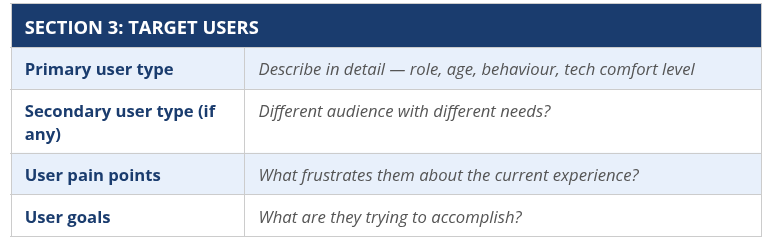
Section 3: Target Users
Who will use this product? Be specific. 'Everyone' is not an audience. 'Mid-level procurement managers at manufacturing companies in western India, 30-50 years old, who compare 3-5 vendors before making a decision and primarily use mobile' is an audience.
If you have different user types (a marketplace has buyers AND sellers), describe each. They have different needs and the design should serve both.
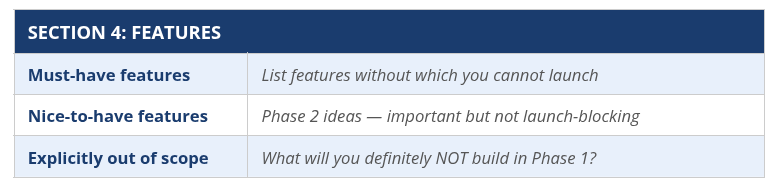
Section 4: Features and Functionality
List what you need the product to do. Separate must-haves (launch blockers) from nice-to-haves (Phase 2). This is where most briefs go wrong — everything ends up in must-have.
A useful exercise: for each feature, ask 'what would a user be unable to do without this?' If you can't answer clearly, it's probably a nice-to-have.
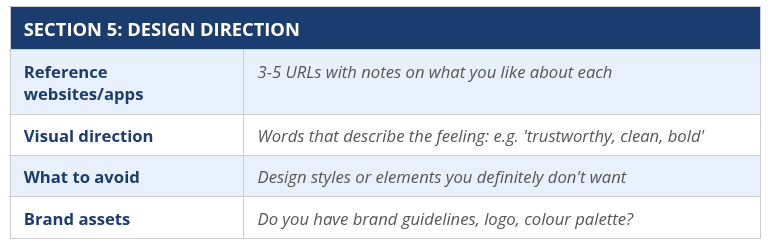
Section 5: Design References
Show, don't describe. Collect 3-5 websites or apps that you feel are in the right direction. Note what you like about each — is it the layout? The colour palette? The way they've structured the navigation? Being specific prevents misinterpretation.
Also share what you DON'T want. 'Not corporate and formal' or 'Not template-looking' gives as much signal as positive references.
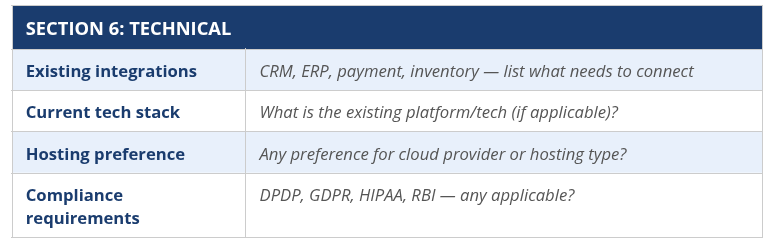
Section 6: Technical Constraints
This is where clients with no tech background often leave gaps — and it's where scope creep costs come from.
Include: Do you have an existing system this needs to integrate with (CRM, ERP, payment gateway, inventory)? What's the existing tech stack if there is one? Do you have hosting preferences? Are there security or compliance requirements (healthcare data, financial data)?
Section 7: Budget Range
Yes, you should share your budget. We know the instinct is to hold back so agencies don't 'use up the whole budget.' But a realistic budget shared upfront produces better work than a low budget concealed until negotiations.
Why: If your budget is ₹5 lakhs, an agency can tell you what's achievable in that range and scope accordingly. If you don't share it, they'll propose what they think you want — which may be ₹15 lakhs — and you'll spend two weeks renegotiating scope instead of building.
You can share a range: 'Our budget for Phase 1 is ₹5-8 lakhs. Phase 2 is subject to Phase 1 outcome.' That's honest and useful.
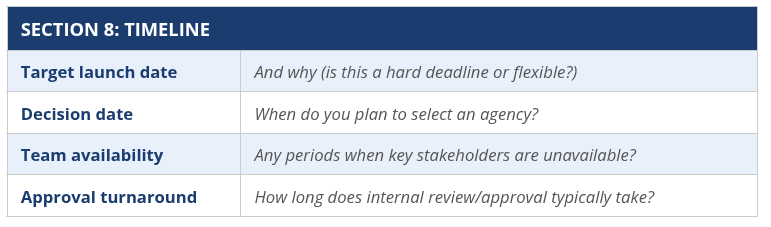
Section 8: Timeline and Constraints
When do you need to launch, and why? (If the deadline is for a trade show, an investor meeting, or a product launch, say so — it helps the agency understand if the timeline is negotiable or fixed.) Are there blackout periods when your team is unavailable for reviews and approvals?
Approval delays are the #1 cause of project timeline overruns. If your review cycle takes two weeks per round, factor that into the timeline from the start.
The Free Brief Template
Use this template as-is or adapt it. Fill every section before approaching an agency.

What Happens When You Share a Good Brief
We'll be direct: the quality of brief you share tells us a lot about what working with you will be like. A detailed, thoughtful brief signals an organised client who knows what they want. Agencies prioritise these projects.
With a good brief, we can typically provide an accurate scope and timeline within 48 hours instead of 2 weeks of back-and-forth discovery calls. The project starts faster, the team is aligned from day one, and the chances of a 'that's not what I expected' moment at launch drop significantly.
If you work through this template and find you can't answer some sections — that's valuable information. It tells you what you need to figure out before you engage anyone. Better to know that before you sign a contract than after.
Ready to Send Your Brief to 12Grids?
Fill in the template above and send it to us. We'll review it, come back to you with clarifying questions if needed, and give you an honest, detailed response — not a templated quote.
→ Send Your Brief: sales@12grids.com
→ Or book a discovery call: Here | +91 91379 97497
Author

Ravindra Warang
Director - Strategy
Share
Share
Related
_desktop_list_webp_016bc11c.webp&w=640&q=75)
Project Management
AI Product Development in India:What's Real, What's Hype, and What It Actually Costs
10 mins : 05 Mar 2026

Project Management
The Silent Pillar of Successful Projects : Stakeholder Management
7 mins : 22 Jul 2024
Project Management
Top 10 Project Management Methodologies: An Overview
7 mins : 21 Mar 2024
Other Articles
_desktop_list_webp_cf6f183b.webp&w=640&q=75)
Marketing
Kadambari Bendre recognised among 10 Best Marketing Leaders in India 2026
2 mins : 05 May 2026
_desktop_list_webp_d12ff3cb.webp&w=640&q=75)
Web Development
How Much Does AI Website Development Cost in India 2026 Real Numbers | Every Feature Priced
15 mins : 22 Apr 2026

Marketing
AI Marketing Automation for Indian Businesses : What's Working, What's Overhyped, and How to Start
9 mins : 21 Apr 2026