



Project Management
AI Product Development in India:What's Real, What's Hype, and What It Actually Costs
10 mins | 05 Mar 2026
_016bc11c.png&w=2048&q=75)
The AI Sales Pitch That Should Make You Suspicious
If an agency tells you AI will 'transform your business' without first asking what specific problem you need to solve — leave the room.
We're at a strange moment in technology. AI has gone from research labs to LinkedIn buzzword in about two years. Every agency now claims to 'build AI products.' Every pitch deck has a slide about 'AI-powered solutions.' And every founder we talk to is somewhere between genuinely curious and completely overwhelmed.
Here's what 9 years of building real digital products for real businesses has taught us: the companies that get value from AI treat it as a tool that solves a specific problem. The companies that waste money on AI treat it as an identity statement.
AI is not a product category. It's a capability. The question is never 'should we do AI?' — it's 'which specific, measurable problem would AI solve better than what we're doing now?'
This guide will help you cut through the noise. We'll tell you what's genuinely possible, what's still hype for most Indian businesses, and what things actually cost.
The AI Use Cases That Are Actually Working for Indian Businesses
Let's separate what's proven from what's still experimental:
Working Well — Proven ROI in Indian Context
Conversational AI for customer support: WhatsApp-based chatbots handling order status, FAQs, and lead qualification are delivering genuine ROI. The integration of WhatsApp Business API with AI backends is mature, cost-effective, and works well in India's mobile-first environment. We've implemented this for e-commerce clients where the bot handles 60-70% of queries without human escalation.
Document processing and extraction: Automating the extraction of data from invoices, purchase orders, and forms — replacing hours of manual data entry. Particularly valuable for logistics, finance, and manufacturing companies processing hundreds of documents daily. Accuracy is 90-95%+ on structured documents, lower on handwritten content.
Product/content recommendations: E-commerce recommendation engines (people who bought X also bought Y) are well-established. The more interesting opportunity for Indian e-commerce is price sensitivity models — showing different product tiers based on browsing behaviour signals.
AI-assisted content generation: Using LLM APIs (OpenAI, Anthropic, Google) within your product to generate product descriptions, summarise documents, or assist with customer communications. Not as a replacement for human writers, but as a productivity multiplier — reducing time from brief to first draft by 70-80%.
Still Experimental — Be Careful
Fully autonomous AI agents: AI that takes actions in your system without human review. Currently more exciting in demos than in production. The failure modes are expensive and unpredictable. We recommend human-in-the-loop for any AI that takes consequential actions.
Real-time demand forecasting for Indian retail: The data quality required (clean historical data, consistent SKU management, accurate inventory records) is genuinely hard to achieve in Indian retail operations. We've seen multiple projects stall because the underlying data wasn't clean enough to train on.
Computer vision for quality control in SME manufacturing: Works beautifully in large-scale, consistent manufacturing environments. More variable in SME settings where lighting, positioning, and product variation make training harder.
Real Costs: What AI Development Actually Costs in India
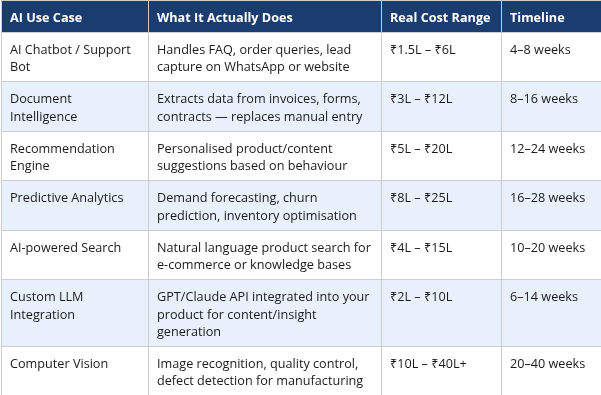
Note: These are build costs. Running costs (API calls, hosting, model inference) vary significantly by usage volume. An AI chatbot handling 10,000 conversations/month has meaningfully different running costs than one handling 10,000/day.
Build vs. Buy vs. Integrate: The Three AI Paths
Path 1: Integrate existing AI APIs
OpenAI, Anthropic (Claude), Google Gemini, and AWS AI services offer powerful AI capabilities through API calls. You pay per use, you don't need to train models, and development time is dramatically shorter. For most Indian businesses, this is the right starting point.
Example: Integrating Claude API into your customer support system to intelligently route and respond to queries costs ₹2-5L to build and ₹20,000-₹2L/month to operate depending on volume.
Path 2: Use pre-trained open-source models
Models like Llama, Mistral, and Whisper (for speech) are open source. You can host them yourself, fine-tune on your data, and pay for compute rather than API calls. More complex to set up, but lower running costs at scale and full data privacy.
Example: A company processing sensitive documents (financial records, legal contracts) often prefers self-hosted models where data never leaves their infrastructure.
Path 3: Train custom models
Training a model from scratch on your proprietary data. This is expensive (₹20-50L+ for a meaningful model), requires significant data preparation, and is only justified when your problem is genuinely unique and your data volume is large. For most Indian businesses in 2026, this is premature.
Our recommendation: Start with API integration. Validate the use case and measure ROI. Only move toward custom training when you have proven demand and data volume to justify it.
The Data Reality Check
This is the conversation every AI project needs to have before anything else:
AI is only as good as the data it's trained on or operates with. Before any AI development project, ask yourself:
- Is your data structured and accessible, or scattered across Excel files, WhatsApp messages, and email threads?
- How much historical data do you have? (Most ML models need at least 12-18 months of quality data to produce reliable predictions)
- Is your data labelled? (For supervised learning tasks, you need labelled examples — which often means manual human labelling first)
- Do you have data privacy compliance in place? (DPDP Act compliance in India is now a real requirement — especially for consumer data)
We've seen AI projects delayed by 6 months — not because of technical challenges, but because the client's data wasn't ready. Data preparation is often 40-60% of the project timeline and cost.
What 12Grids Builds in AI — and How We Think About It
Our AI and Intelligent Systems practice is built on one principle: business outcomes first, model complexity second.
We don't propose AI solutions to make proposals look impressive. We ask: what decision or action do you want to improve, and what data do you have to support that? If the answer points to AI, we build it. If it points to a simpler automation solution — Zapier, a well-built rule engine, a structured data pipeline — we build that instead.
Some of what we've built:
- AI-enabled content management for global web platform — a Fortune 500 chemical company — allowing regional content managers to generate localised content variations intelligently
- Conversational AI on WhatsApp Business for e-commerce clients, integrated with their order management and CRM
- Document extraction pipelines for B2B clients in logistics and financial services
- AI-assisted search and recommendation for content platforms
In every case, the AI layer was embedded into a larger product — not bolted on as a feature.
5 Questions to Evaluate Any AI Development Proposal
- What specific metric will this AI feature improve, and by how much? (If they can't name a metric, walk away)
- What data does this require, and do we have it? (If they haven't asked about your data, they haven't thought it through)
- Are we using an existing model/API or building custom? What's the tradeoff?
- What's the ongoing cost — API calls, compute, retraining cycles?
- What's the fallback if the AI produces wrong outputs? (Every AI system needs a human safety net at some point)
Thinking About AI for Your Business?
Let's start with an honest conversation. We'll look at your specific situation, identify where AI creates genuine value, and tell you where it doesn't. No hype. No overpromising.
→ Book a Free AI Consultation: www.12grids.com/contact-us
→ Email: sales@12grids.com | +91 91379 97497
Author

Kailash Vele
Director - Technology
Share
Share
Related
_desktop_list_webp_1fc535ab.webp&w=640&q=75)
Project Management
How to Brief a Digital Agency: The Document That Saves Projects (Free Template Inside)
8 mins : 24 Mar 2026

Project Management
The Silent Pillar of Successful Projects : Stakeholder Management
7 mins : 22 Jul 2024

Project Management
Top 10 Project Management Methodologies: An Overview
7 mins : 21 Mar 2024
Other Articles
_desktop_list_webp_cf6f183b.webp&w=640&q=75)
Marketing
Kadambari Bendre recognised among 10 Best Marketing Leaders in India 2026
2 mins : 05 May 2026
_desktop_list_webp_d12ff3cb.webp&w=640&q=75)
Web Development
How Much Does AI Website Development Cost in India 2026 Real Numbers | Every Feature Priced
15 mins : 22 Apr 2026

Marketing
AI Marketing Automation for Indian Businesses : What's Working, What's Overhyped, and How to Start
9 mins : 21 Apr 2026